Construction is local by nature.
A homeowner planning an extension in Southampton is unlikely to hire a builder based hundreds of miles away. They want a company that works nearby, understands the area and can show evidence of similar projects.
The Southampton SEO services page shows how service relevance, local proof and the enquiry journey can be organised around that city without pretending every nearby town needs the same page.
Local SEO helps your business appear when those people search for the services you provide in the places you actually cover.
For commercial contractors, the construction SEO page for Hampshire explains how that local visibility connects with service architecture, project proof and lead qualification. Residential builders have a separate route because homeowner searches need different content and evidence.
It is not simply about adding town names to a website. Done properly, local SEO connects your services, location, reputation and completed work so potential customers can find and trust your business.
Local searches often come with strong intent
Someone searching for “construction company near me”, “house extension Southampton” or “commercial builders Hampshire” is not browsing construction in general. They are looking for a suitable provider.
That makes local search particularly valuable. It can introduce your business at the point when a potential customer is comparing options, checking recent work and deciding who to contact.
For a compact implementation checklist, see how builders can generate more relevant Google enquiries in Southampton.
Strong visibility does not guarantee an enquiry, but being absent makes it much more likely that the opportunity goes to a competitor.
Local SEO helps you appear in two important places
Local visibility is usually split across Google Maps and the standard organic results.
Google Maps
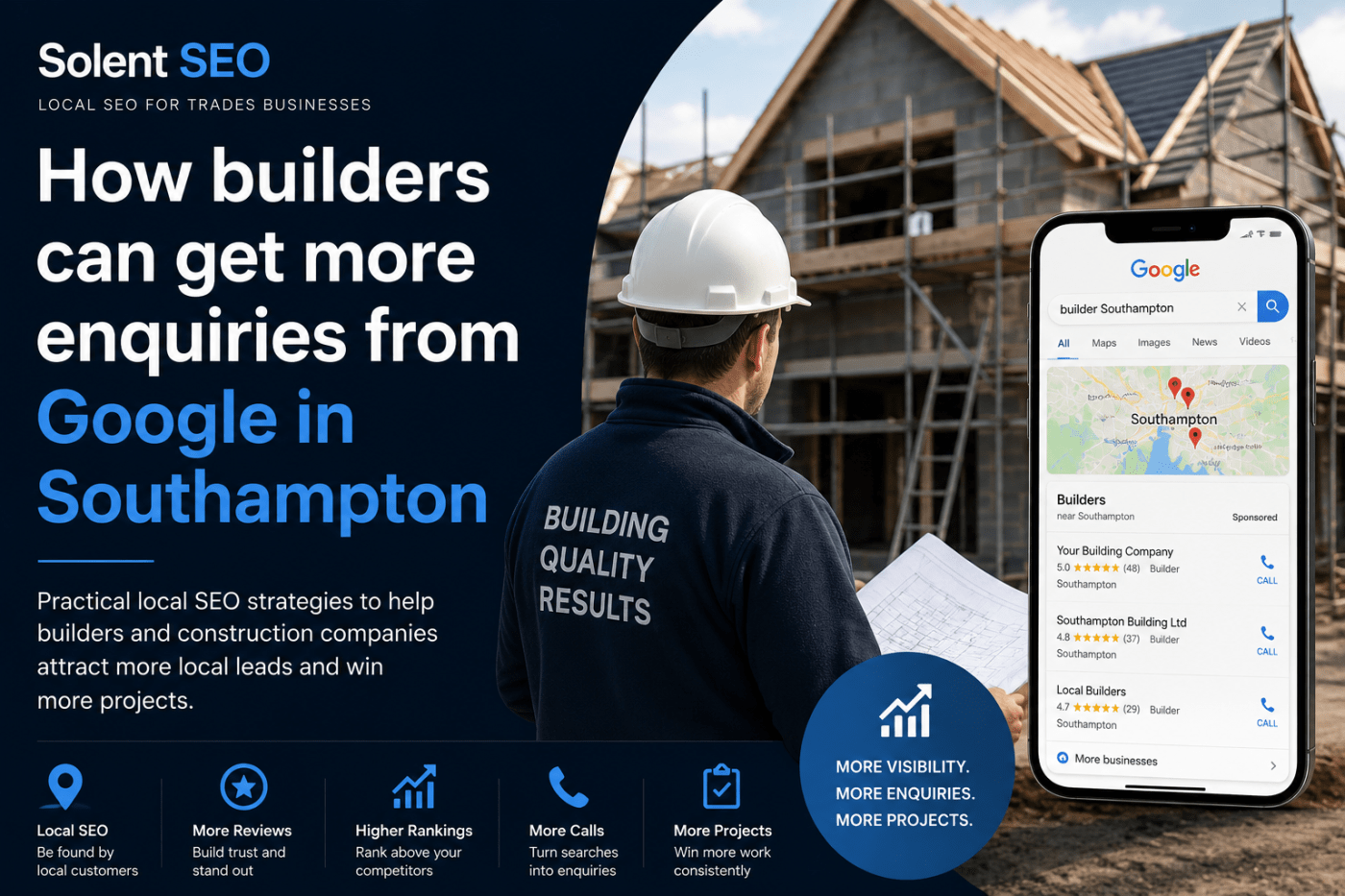
The local map pack often appears prominently for location-based searches. Your Google Business Profile can show your reviews, photographs, opening hours, service information and contact details before someone visits your website.
Google explains that local results are mainly based on relevance, distance and prominence. You cannot control every factor, particularly the searcher’s location, but you can make your business information clearer and build stronger evidence that you are established in the area.
The guide to common Google Maps visibility problems explains those controllable signals in more detail, while Google Maps SEO support can connect the profile with the website rather than treating it as a separate project.
Organic search results
Your website supports a wider range of searches through useful service pages, location pages, project case studies and articles.
For example, one company may need separate pages for house extensions, renovations, new builds and commercial construction. Those services can then be supported by genuinely useful information about the areas covered. Our practical example of planning electrician service pages shows how to separate genuine customer needs without creating a page for every keyword variation.
Your website and Google Business Profile should reinforce each other rather than operate as separate projects. Clear service-page planning gives each important offer a suitable destination for both organic and Maps visitors.
It makes your service area clear
Many construction companies cover several towns, a county or a sensible driving radius. That can be difficult to communicate with a single homepage.
Useful location pages allow you to explain:
- which services are available in that area
- the types of properties or projects you work on
- relevant completed work nearby
- practical details a local customer may want to know
- how to request a quote or arrange a site visit
The important word is useful.
Creating twenty near-identical pages and changing only the town name rarely gives customers a good reason to read them. It can also make the website feel less trustworthy.
A smaller number of strong pages, supported by real local knowledge and projects, is usually a better starting point. Use the location-page planning guide for builders to choose which areas deserve separate URLs without producing near-identical doorway pages.
It builds trust before the first conversation
Construction projects often involve a significant investment, access to someone’s property and weeks or months of work. Customers want reassurance before they make contact.
Local SEO is not only about where you rank. It also improves the information people find when they search for your company.
That can include:
- genuine customer reviews
- recent project photographs
- clear business details
- professional service pages
- case studies with useful context
- consistent contact information across the web
When these signals agree, your business looks more credible. When the address, phone number, services or branding differ from one listing to another, customers may hesitate.
Project pages can do more than display photographs
Completed projects are one of the strongest assets a construction company has.
A useful project page can explain the original brief, location, type of work, challenges, solution and finished result. It gives potential customers evidence that you have handled work similar to theirs.
It also gives search engines more specific context about your experience. A detailed extension project in Winchester is far more informative than a gallery image called “project 12”, and the Winchester SEO location page shows how genuine market context can sit above individual service and project evidence.
Real projects can support both visibility and conversion, which is why they should be part of the SEO strategy rather than hidden in a basic gallery.
Reviews influence visibility and decisions
Reviews help potential customers judge reliability, communication and quality. They can also contribute to the prominence of a business in local search.
Do not wait for reviews to appear by chance. Build a simple process around completed work:
- ask at an appropriate point after the project
- send a direct link to the review form
- make the request personal and easy to complete
- respond professionally to the feedback you receive
A steady flow of genuine reviews is usually more reassuring than a sudden batch followed by a long silence.
Never buy reviews or ask people to describe work that did not happen. Shortcuts can damage the trust you are trying to build.
Local SEO can reduce reliance on lead platforms
Paid advertising and lead-generation platforms can produce work, but the cost often continues for as long as you need the enquiries.
Local SEO takes time, but it can build an asset your business owns: a useful website, a stronger reputation and greater visibility for relevant searches.
That does not mean every construction company should stop advertising. A balanced approach may use paid campaigns for immediate demand while SEO develops over the longer term.
The advantage is choice. Better organic visibility can reduce the pressure to depend entirely on third-party platforms.
It helps attract more relevant enquiries
More traffic is not always the goal.
A construction company does not need thousands of visitors from across the country if it only serves Hampshire. It needs the right people, in the right areas, looking for the right type of project.
Clear service and location pages can help filter enquiries before they arrive. Customers can understand what you do, where you work and whether their project is a suitable fit.
That can make SEO more useful to the business than chasing broad traffic numbers.
A practical local SEO starting point
If your online presence has been neglected, begin with the foundations:
- Complete and verify your Google Business Profile.
- Keep your business name, contact details and service areas accurate.
- Create a clear page for each main construction service.
- Add useful location pages for the areas that matter most.
- Publish detailed case studies from real projects.
- Ask satisfied customers for honest reviews.
- Make the website fast, mobile-friendly and easy to contact.
- Track calls and enquiries so you know what is working.
You do not need to do everything at once. Consistent improvements are more valuable than a short burst of activity followed by months of silence.
The local SEO service can bring those foundations into one plan. Plumbing businesses can also follow the more specific Southampton local SEO guide for plumbers, while lead-tracking support connects visibility with suitable project opportunities.
For more common issues, read the biggest SEO mistakes construction companies make.
Paid placement is also appearing more often inside local results. The guide to local pack ads for roofers explains when immediate paid visibility can complement, rather than replace, this long-term work.
Final thoughts
Local SEO is important for construction companies because it connects online visibility with a genuinely local service.
It helps your business appear when nearby customers are actively looking, shows where you work and gives them the proof they need to take the next step.
The strongest strategy is not built on town names alone. It combines a complete Google Business Profile, useful service and location pages, real projects, consistent information and genuine reviews.
Get those foundations right and your website can become a more reliable source of relevant enquiries over time.
Frequently asked questions
Does local SEO work for construction companies?
Yes. It is particularly useful for businesses serving defined locations and offering services that customers actively search for. Results depend on competition, the starting point and the quality of the work completed.
How long does local SEO take?
Some improvements, such as correcting business details, can be made quickly. Meaningful ranking and enquiry growth often takes several months of consistent work, especially in competitive areas.
Do construction companies need location pages?
Location pages can help when they are genuinely useful. Each page should contain relevant services, local context and real evidence rather than repeating the same copy with a different town name.
Is a Google Business Profile enough on its own?
Usually not. A strong profile is important, but your website, reviews, project content, local mentions and business information all contribute to the wider picture.