Lead with the core offer
Kitchen fitting and home renovations are stated clearly on the homepage, with supporting routes into bathroom renovations, flooring and tiling, painting and plastering, full renovations and carpentry.
Client case study
How a blank starting point became a clear, locally focused website that presents the work, answers the right questions and gives homeowners simple ways to enquire.
01 — Starting point
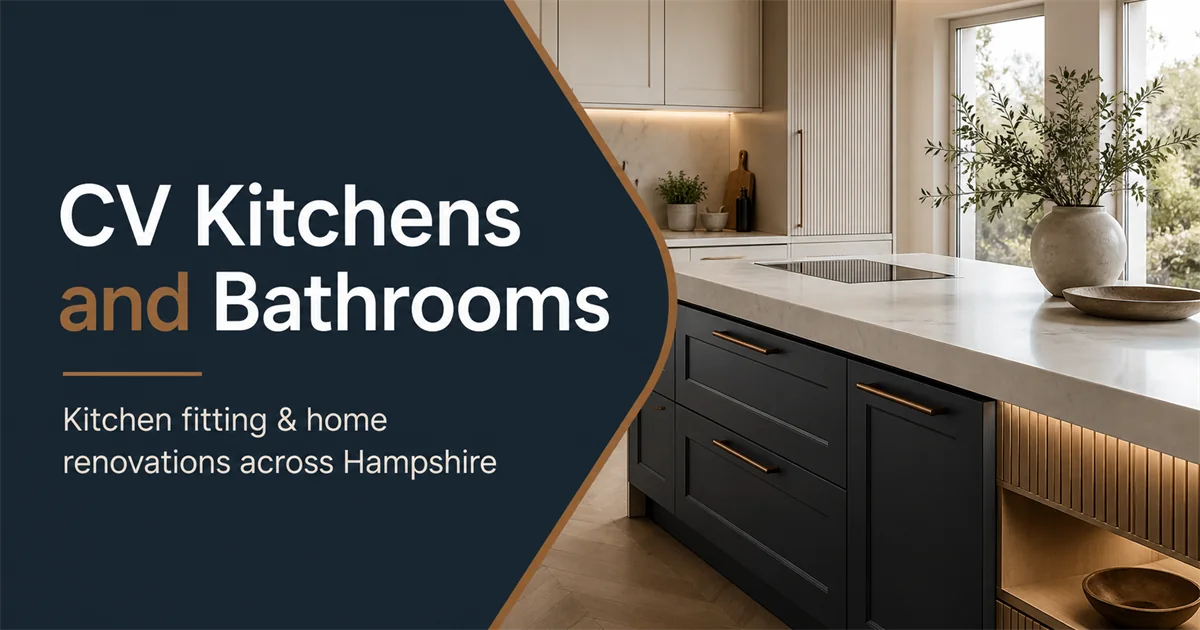
CV Kitchens and Bathrooms needed an owned online presence for its kitchen fitting, bathroom renovation and wider home-improvement work. This was not a redesign with an existing site map, content library or search history to work around. The website was created from scratch.
That freedom was useful, but a blank page creates its own challenge. Every early decision—what to lead with, how to group services, which locations deserved dedicated information and where to place proof—would shape how homeowners understood the business and how search engines interpreted the site.
The objective was therefore broader than making something attractive. The new website needed to explain the offer quickly, show the scope and quality of the work, establish local relevance and turn interest into an easy next step.
The central principle
A trades website should help a homeowner answer three questions: do you provide what I need, do you work where I live, and can I trust you with my home?
02 — The approach
The structure was built around the decisions a potential customer makes rather than a list of SEO keywords. A visitor arriving from search should be able to identify the main service, confirm the geographical fit, see relevant work and contact the business without hunting through the site.
Kitchen fitting and home renovations are stated clearly on the homepage, with supporting routes into bathroom renovations, flooring and tiling, painting and plastering, full renovations and carpentry.
An area hub and individual location pages give homeowners a direct route to information about coverage across Hampshire and the South Coast.
Finished project photography and service-specific information help visitors assess the work before they are asked to make contact.
Phone, email and WhatsApp routes are available so visitors can use the contact method that suits the stage of their project.
03 — What was built
The completed site is a fast, responsive Astro website with a connected page structure rather than a single brochure page. Its foundations include:
These elements do different jobs, but they support the same journey. A location page can establish relevance, a service page can explain the work, the project gallery can reduce uncertainty, and a visible contact route can capture the enquiry.
For similar businesses, this is where well-planned service pages, local SEO and Google Maps optimisation work best together rather than as separate tactics.
The client’s view
“Solent SEO created our website from scratch, manages our Google Business Profile and takes care of online work we would not know where to begin with ourselves. Misitia has shown us opportunities we did not even know were possible, and we have been really pleased with the results.”
CV Kitchens and Bathrooms
Solent SEO client
04 — The outcome
CV Kitchens and Bathrooms now has a structured website that makes its services, local coverage, completed work and contact options easy to understand. The business is no longer relying on a social profile or directory listing to explain the full offer; it has an owned platform that can be expanded as new projects, services and evidence become available.
The project also created a cleaner foundation for future work. Search performance can be reviewed through real data, important service and location pages can be refined, and calls or enquiries can be measured with appropriate lead tracking.
This page documents the verified starting point, completed website and visible local-search foundations. It does not claim a numerical increase in traffic, rankings, enquiries or revenue because comparable first-party performance data has not been presented here. Any future performance update should be based on Search Console, analytics and genuine enquiry records.
05 — Lessons for trades businesses
A new website does not need dozens of pages on launch. It needs a clear commercial structure that can expand without becoming confusing. For a builder, kitchen fitter, bathroom installer or renovation company, that usually means:
If an existing website has accumulated unclear pages or technical problems, an SEO audit can identify the highest-priority gaps. If the structure is sound but the explanations are weak, content optimisation may be the more useful starting point.
Start a conversation
Tell me a little about your business and what you would like to improve. I’ll come back to you with a clear next step.